⁂
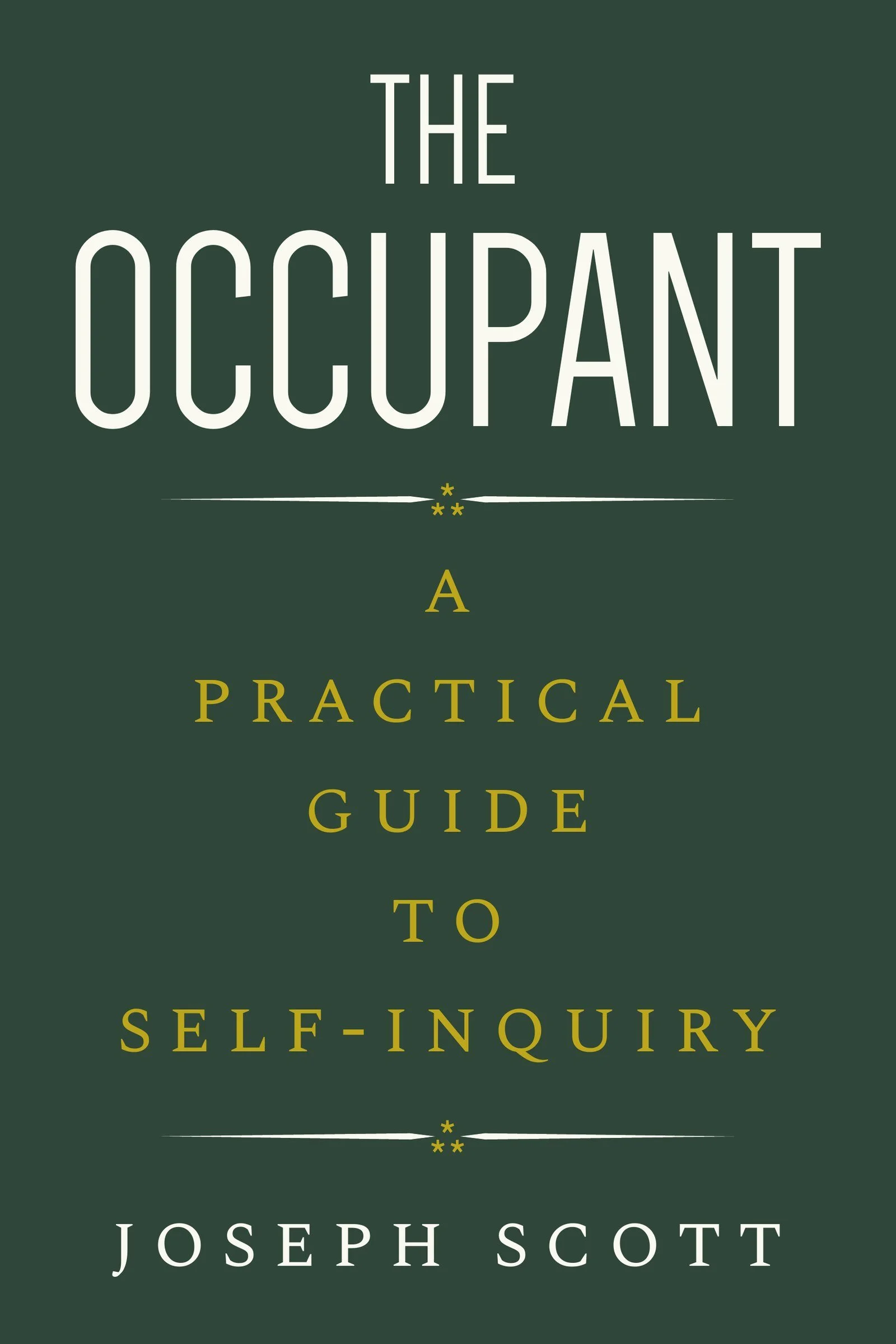
THE OCCUPANT
A Practical Guide to Self-Inquiry
Joseph Scott
Coming 2026.
You’ve tried things. Perhaps therapy, which helped but didn’t resolve it. Perhaps meditation or mindfulness, which produced calm but left the underlying restlessness untouched. Perhaps self-help, spiritual seeking, periods of intense focus on becoming better — followed by quietly going back to what you were.
There is a reason for that. The part of you that made those commitments is the same part that couldn’t keep them.
The Occupant is an inquiry into that part: the conditioned sense of self — the voice in your head, the accumulated story, the knot of feeling — that this work calls the Occupant. It is not a program for self-improvement. It is a practical map of how the sense of being a separate someone is generated, moment to moment, and what it takes to stop generating it.
What’s inside
Part One works with what is directly observable: the Occupant, its patterns, and the mechanism that sustains it — a sequence precise enough to notice in real time, and to interrupt.
Part Two moves into territory that can only be pointed at: what practitioners consistently report as the Occupant’s activity quietens. The book is honest about the difference between these two kinds of claim, and holds both.
Throughout, the inquiry is grounded in composite stories drawn from twelve years of real sessions — a managing director, a retired principal, a nurse, a psychotherapist, a philosophy student — people whose patterns you may recognise because, underneath the details, they are everyone’s.
Not information. A mirror.
Read this book not as information to collect, but as a mirror to look into. The questions in it are not rhetorical. They are meant to stop you, just for a moment, in the middle of your habitual forward motion — and in that pause, something may become obvious that has always been true.
Be first to know.
The book is in its final stages before publication. Leave your email to hear the moment it’s available — and nothing else before then.
This book describes a phenomenological inquiry offered for general information and educational purposes. It is not therapy, and not a substitute for professional medical, psychological, or psychiatric assessment or treatment. If you are experiencing psychological distress, or have a history of psychiatric illness, please consult a qualified clinician before undertaking the practices described.